Mr. William N.
Tackitt was stationed at Misawa Air Force Base, Japan at the
outbreak of the Korean War. Mr. Tackitt was on TDY
(Temporary Duty) at Iwo Jima when war broke out.
Below are a series of images
taken by Mr. Tackitt during his short tour of the
island.
It should be noted that some
of the images near the bottom of this series of images are
of importance. They were taken five years following the
bloody fighting for the island in February and March
1945.
Some of the images show
destruction that occurred during this heavy fighting. The
equipment in these stunning images lay there for five years
following the intense battle and remained there as mute
testimony to the brutality of the fighting going on between
determined American Marines and equally determined Japanese
soldiers and Marines.
Images are worth a thousand
words.
These images speak
volumes!
----- the web
master
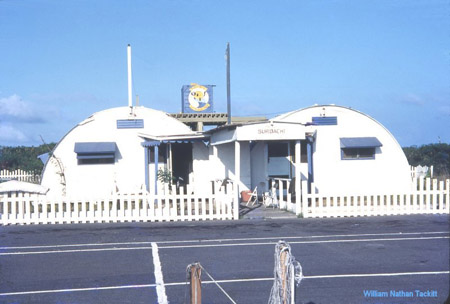
TDY Quansont
huts on Iwo Jima. Circa 1950.
"The first
picture of the quansan huts are the ones we stayed in on Iwo
Jima. The water tower between the two huts had the insigna
that Air Rescue used on Iwo Jima (a sea-sick cat wearing a
Mae West life perserver."
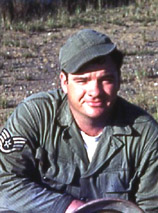
"The picture was
taken on the Island of Iwo Jima at the outbreak of the
Korean War. We were pulling "strip alert" at the time. A
japanese worker came by and stole the hat a couple of hours
after the picture was taken. I guess he needed a good hat.
Ha. We were there when the war broke out but due to war time
traffic on the radios, we could not find out where war had
started."
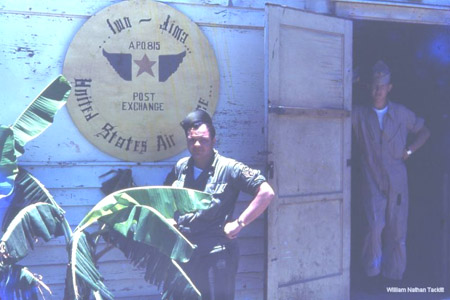
Iwo Jima --
APO815 -- Post Exchange on Iwo Jima. Circa 1950.
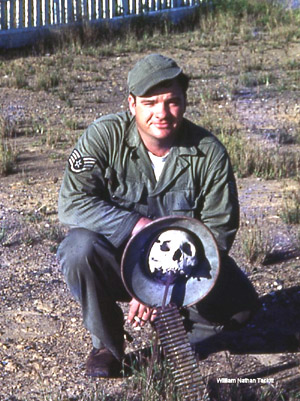
Japanese skull,
helmet and machine gun belt on Iwo Jima. Circa
1950.
"Japanese skull
and bullets. There were still a few in caves and tunnels. We
went into one that had opened up due to cave in below it
that had a skeleton of a japanese officer there. He was
still covered with some of his uniform.
As we were
looking, someone stepped on a board that was under the
skeletons hand and it looked like he saluted us because the
board threw his hand up.
We vacated the
area very quickly. Ha."
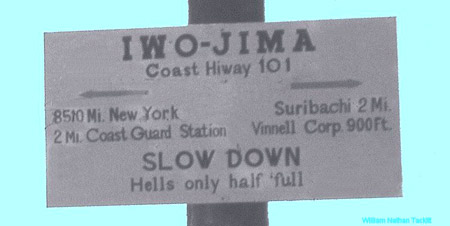
"Slow Down" sign
on Iwo Jima. Circa 1950.
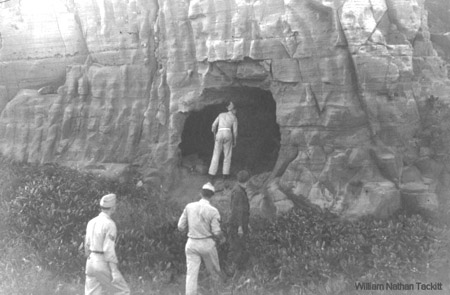
Cave on southern
side of the island, just above the Invasion Beaches on Iwo
Jima. Circa 1950.
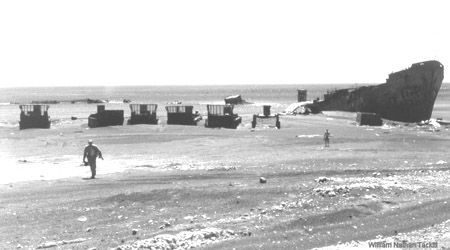
Invasion beaches
damaged and destroyed equipment on Iwo Jima. Circa
1950.
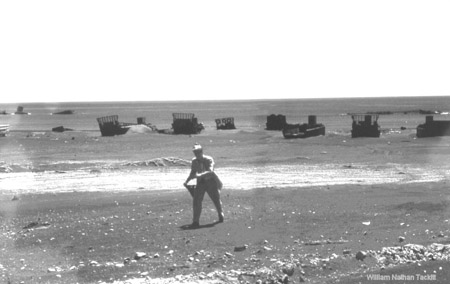
Invasion beaches
damaged and destroyed equipment on Iwo Jima. Circa
1950.
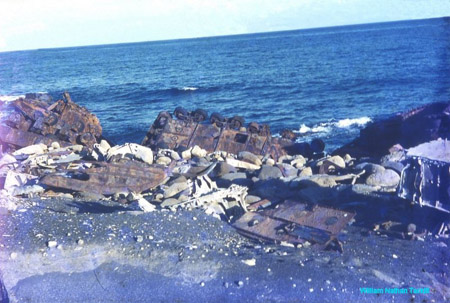
Invasion Beaches
-- destroyed equipment -- on Iwo Jima. Circa
1950.

Invasion Beaches
-- destroyed equipment -- on Iwo Jima. Circa
1950.
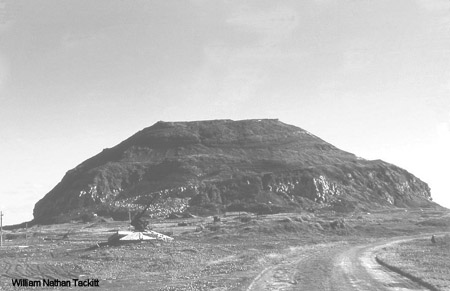
The "Rock" --
Mt. Suribachi. Looking to southwest. Notice an artillery
piece to left side of the bend in the road. Iwo Jima. Circa
1950.
"I was stationed
at Misawa AB when the Korean war broke out, however I was
TDY on Iwo Jima at the start of Korean War. Confusing isn't
it. Ha. Our rescue unit pulled strip alert on Iwo Jima and I
just happened to be there when the North Koreans invaded the
south. We couldnt find out what was happening as
communications were all tied up with war traffic and it was
coded. A ham operator tried to find out and was told to shut
up and get off the air unless was handling wartime traffic.
That really got us to going."
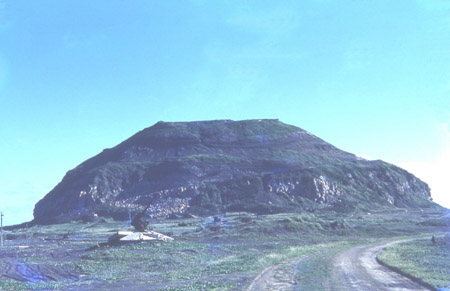
Road to Mt.
Suribachi -- color image -- Iwo Jima. Note the access road
circling the volcano as it leads to the top. This is
apparently a color version of the image depicted above.
Circa 1950.
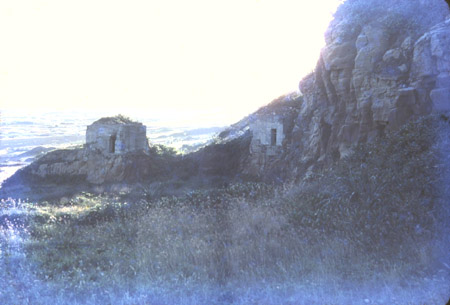
Remnants of
Japanese defenses near base of Mt. Suribachi on Iwo Jima.
Circa 1950.
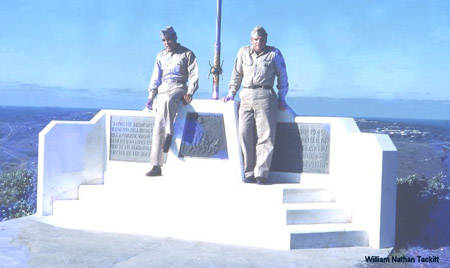
At the "Flag
Raising Memorial" atop Mt. Suribachi on Iwo Jima. Circa
1950.
Biography of
William N. Tackitt
Now you can read
the most interesting life story of William N. Tackitt as
written by himself.
Biography
of William N. Tackitt
Note: To view
images taken by the web master on World War II Stories -- In
Their Own Words during his year on Iwo Jima, please click on
the following link to my World War II Stories Photo
Album:
WW
II Stories: Iwo Jima Photo Album
1965-1966
Did YOU serve on Iwo Jima?
Did you know that
there is a group of veterans who have gotten together to
form an association of servicemen, no matter what branch of
service, who served at one time or another starting at the
invasion of the island on February 19, 1945 and continuing
until the island was eventually returned to the Japanese in
1968?
Iwo
Veterans Organization
We, at the
Iwo
Jima Memoirs web site wish to offer to Mr. Joseph Pellam
our most profound THANK YOU for his poignant story of his
personal experiences -- during his tour of Iwo Jima and
especially for allowing us to share those
memories.
Original story/images transcribed on 13 June
2004.
Did YOU serve on
Iwo Jima?
Do YOU have
a story to tell?
Do YOU have a picture or pictures
that tells a story?
Contact me, Joe
Richard and I can help by adding YOUR story to my site
devoted to veterans who served on Iwo Jima.
Check out my
other web site on World War II. Click on the Image
Below: